






Top 10 ultrasonic wire harness welding machine manufacturers in the world
 Aug 31, 2026|
 View:590
The global ultrasonic welding machine market reached USD 2.4 billion in 2024, and it may hit USD 3.7 billion by 2030. This growth comes from the high need for strong connections in cars and electronics. A single luxury car has over 4,000 connection points. You need good solutions, and choosing the right ultrasonic wire harness welding machine manufacturer saves you time and costly mistakes.
Here are the top ultrasonic welder manufacturers:
Branson (Emerson)
Telsonic
Herrmann
SharperTek
Eastontech
Bonne Ultrasonic
Jiangsu Bozhiwang
Shenzhen Jietong
Wuxi Nico
Sonics
We ranked these leaders on quality, reliability, new ideas, and customer support. For ultrasonic metal welding, each one does best in certain jobs. Read on for full details and a simple guide to pick the right ultrasonic wire harness welding machine for your wire harnesses.
Key Takeaways
Pick a manufacturer that fits your production size, wire kinds, and quality needs.
Look for machines with digital controls, automation features, and real-time monitoring to keep quality steady.
Think about the full cost of owning the machine, including energy savings and how long the tooling lasts, not just the price you pay upfront.
Ultrasonic welding is environmentally friendly, using less energy and no solder or flux, helping meet sustainability goals.
Future changes include IoT connectivity, AI integration, and energy-saving designs for smarter production.
Ranking Methodology
Evaluation Criteria
You need a clear framework to compare ultrasonic wire harness welding machine manufacturers. We looked at each company in five main areas. These areas show what matters most on your production floor.
Evaluation Dimension | What We Assessed |
|---|---|
Innovation | R&D spending, patented tech, smart controls, new machine models |
Product Range | Handheld units to full automated systems, custom horns, ready-to-integrate platforms |
Global Reach | Presence in key manufacturing regions, North American support, local stock |
Customer Satisfaction | Reliability, ease of use, steady process, training quality, after-sales help |
Sustainability Focus | Energy savings, eco-friendly design, less waste, greener processes |
Innovation, customer satisfaction, and US market support weigh the most in our scoring. These factors affect your daily work and long-term success.
Quality and reliability need a closer look. We checked compliance with ISO 9001 and ISO 14001 standards. We also reviewed digital quality logs, closed-loop amplitude control, and force-time-energy monitoring systems. These features keep weld quality steady across high-volume production runs.
The USCAR-38 specification defines test methods for checking weld quality in automotive use. This standard covers temperatures from -40°C to +150°C. Key acceptance criteria include full strand welding, proper weld containment, and no scorching or contamination. Test steps include visual checks, cross-section analysis, tensile testing, and thermal shock conditioning. Manufacturers who meet these standards show real commitment to quality.
Data Sources
We gathered information from many reliable sources. Industry reports gave market share analysis and technology trends. Customer reviews showed real-world performance and support experiences. Technical specs from each manufacturer allowed direct feature comparisons.
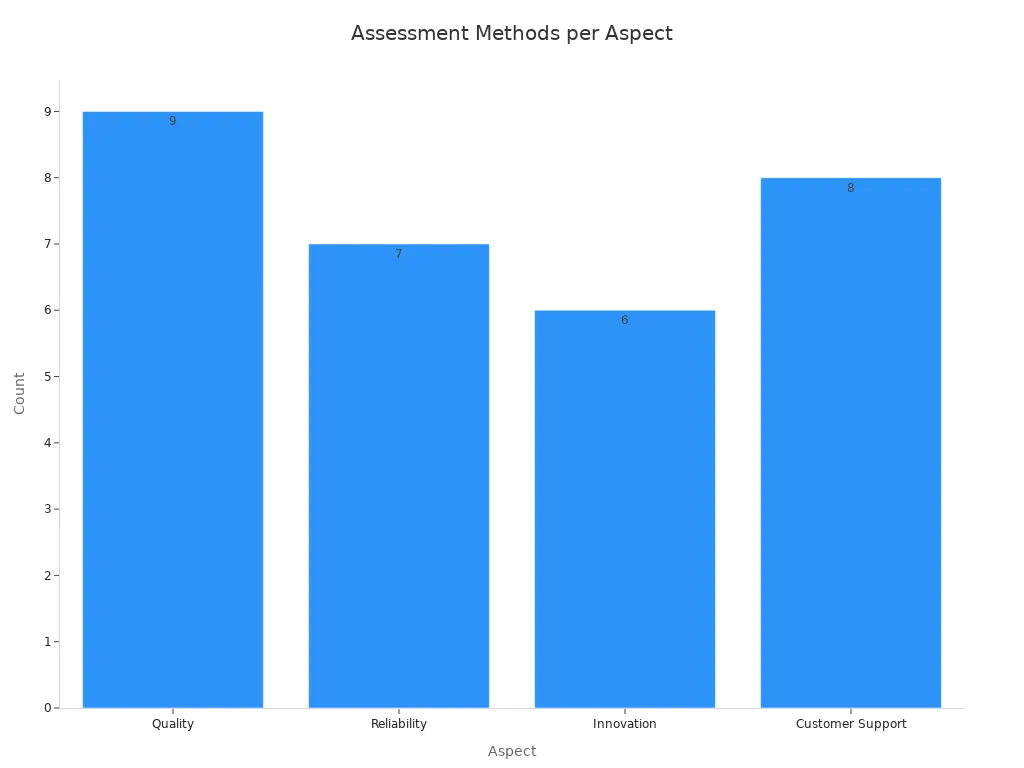
Reliability checks focused on uptime expectations, first-pass yield, and overall equipment effectiveness. We reviewed predictive maintenance abilities and process stability records. Customer support evaluation looked at service contracts, global coverage, spare stack availability, and local application labs. Fast spare parts delivery and calibration services also played a part in our rankings.
This method gives you an honest, practical review. Each manufacturer earned their spot through proven performance, not marketing claims. Use this framework yourself when comparing suppliers for your specific wire harness welding needs.
Top 10 Manufacturer Profiles
The ultrasonic welding machine market has two main groups. Big global companies lead with many products and large research budgets. Smaller experts focus on specific jobs and often give better custom solutions than the big companies. Knowing both types helps you pick the right supplier for your production needs.
Global Leaders
Branson (Emerson) is the top name for reliable and precise ultrasonic metal welding. Their systems include robotics, AI monitoring, and energy management. Car makers in North America and Europe use Branson machines for EV production, especially for battery parts and wiring. In 2024, Branson teamed up with a major automation company. This partnership links ultrasonic welding with robotic assembly lines, giving fully automated, high-speed solutions for cars and electronics. If you need a proven ultrasonic wire harness welding machine manufacturer with strong integration, Branson is the best choice.
Herrmann Ultrasonics builds modular automatic welding systems for EV battery tabs, collection rails, and hybrid parts. The company focuses on low defect rates and easy setup in existing production lines. Herrmann's 2024 UltraWave series targets high-frequency precision welding for medical and electronics uses. This series allows micro-welding with little heat, which helps when working with delicate wire harnesses. Herrmann's strong application support sets it apart. You get deep process knowledge with the equipment, cutting down your trial-and-error time a lot.
Telsonic brings skill in process optimization and equipment customization. The company welds plastic, metal, and hybrid parts, focusing on fast connections and inline monitoring. Telsonic's global service network means you get support wherever you produce. Their systems give reliable operation for both EV and traditional engine production lines. For manufacturers wanting a partner who customizes equipment to specific process needs, Telsonic offers great flexibility.
Manufacturer | Market Position | Key Innovations |
|---|---|---|
Emerson (Branson) | Top 7 player, ~72% market share | Robotics integration, AI monitoring, energy management |
Herrmann Ultrasonics | Top 7 player, ~72% market share | Modular EV systems, UltraWave micro-welding series |
Telsonic | Top 7 player, ~72% market share | High-speed connection, inline monitoring, customization |
These three companies lead market change by setting high standards for quality, performance, and customer satisfaction. Their automated ultrasonic welding systems are the latest in production efficiency.
Niche Specialists
SharperTek excels in high-voltage wire harness applications for EV and hybrid vehicles. Their ultrasonic metal welding gives low electrical resistance and high mechanical strength for safe power flow under high current loads. SharperTek also serves communication cable makers, keeping signal integrity for Ethernet, RF, and coaxial cables.
Eastontech makes heavy-duty machines for tough environments. Their 6500W model handles large cross-section conductors easily, making it great for energy storage battery connections and busbar links. This machine gives ultra-low resistance joints that boost thermal stability and durability.
Bonne Ultrasonic focuses on wire to wire welding. Their equipment handles end splices, butt splices, inline splices, and head-to-head setups. Bonne also offers ultrasonic spot welding, a newer feature that creates stronger joints than old soldering methods.
Jiangsu Bozhiwang offers a full line of ultrasonic welders for wire harnesses. The BZW-9A and BZW-9A-1 models join wire harnesses with speed and accuracy. The BZW-9A-02 portable unit gives mobility without losing performance. The BZW-9B and BZW-9C terminal welding machines handle terminal-to-wire connections with strong, lasting joints. Bozhiwang's easy controls and solid build ensure long-term reliability. Their machines give high joint strength without solder or flux, supporting eco-friendly production.
Shenzhen Jietong and Wuxi Nico serve the Asian manufacturing market with budget-friendly options. Both companies offer reliable equipment for standard wire harness production, focusing on steady quality at competitive prices.
Sonics completes the list with flexible systems for both plastic and metal welding. Their equipment serves automotive, electronics, and medical device makers worldwide.
These niche specialists show that smaller manufacturers often give better solutions for specific jobs. Your choice depends on your production volume, wire types, and required weld quality.
Comparing the Leaders
Technology and Innovation
You need to know how these machines differ in power, automation, and ease of use. Frequency sets the power traits. Low-frequency systems at 15kHz give the most amplitude for big parts. Mid-frequency units at 20kHz handle strong metal welding with deeper reach. High-frequency systems at 35/40kHz offer finer control with less marking on delicate parts.
Automation features separate basic machines from advanced production systems. Digital generators with auto frequency tracking keep weld quality steady. Programmable amplitude controls allow soft start, steady state, and controlled decay phases. These features create strong metal bonds across high-volume runs. Modern digital controls include touchscreens, recipe storage, and data export. You can save settings for different wire harness setups and pull them up instantly.
Connectivity matters for tracking. Leading automated ultrasonic welding systems offer PLC integration, HMI interfaces, and data export through Ethernet, RS232, or USB. Each cycle records time, energy, power, and distance data. Automotive and medical fields need this level of documentation. Closed-loop control gives you full command of the welding process. Servo-driven weld heads provide exact positioning for delicate jobs like EV battery foil stacks.
Frequency | Power Output | Automation Features | Ease of Use |
|---|---|---|---|
15kHz | Maximum amplitude for large parts | Robust mechanical construction | Basic controls |
20kHz | High-power metal welding, deeper penetration | Digital generators, programmable amplitude, automatic frequency tracking | Touchscreen, recipe storage, data export |
35/40kHz | Lower power, finer control, minimal marking | Real-time monitoring, force detection, full traceability | Programmable depth stops, energy modes |
Support and Service Networks
Your choice of ultrasonic welder manufacturers depends a lot on after-sales support. A machine that sits idle due to poor service costs you money every hour. Global leaders keep wide networks. Herrmann Ultrasonics runs labs in 20 countries, offering local application help. Their 360° engineering approach covers you from start to after-sales.
Bozhiwang shows strong commitment to customer service. They offer free consultation and model selection advice. Customized technical training fits your specific production needs. You get full visibility into the manufacturing process with detailed inspection documents. Their support package includes a one-year warranty, unlimited technical help, and 24/7 engineer availability. They promise an 8-hour response time for urgent issues.
Herrmann Ultrasonics, a leading global provider, offers 360° ULTRASONIC ENGINEERING with customer-specific support from concept to after-sales. The company maintains ultrasonic laboratories in 20 countries, providing local support as part of its global network.
Market analysis shows that premium suppliers win in regulated industries through technical edge and strong service networks. Cost-competitive makers reach price-sensitive markets with faster delivery. Your production location matters. North American operations benefit from Dukane and Sonics' established distribution. European buyers access Telsonic and Rinco's advanced joining solutions. Asian manufacturers find responsive support from regional players.
When you evaluate ultrasonic metal welding equipment, factor in total support costs. Training programs, spare parts availability, and calibration services affect your long-term operational efficiency. Choose an ultrasonic wire harness welding machine manufacturer that matches your geographic footprint and production complexity.
How to Choose an Ultrasonic Wire Harness Welding Machine Manufacturer
Selecting the right equipment partner determines your production efficiency and product quality. You need a systematic approach that matches machine capabilities to your specific manufacturing reality. This section walks you through the critical assessment steps.
Assessing Production Needs
Start with your production volume. Ultrasonic welding requires a higher initial equipment investment but delivers faster cycle times, repeatability, and automation readiness. These advantages make it ideal for consistent, high-volume manufacturing. In contrast, splicing uses low-cost tools but relies on manual labor, leading to longer build cycles and more variation. High-volume environments should prioritize ultrasonic welding's speed and consistency. Low-volume or flexible setups may not justify the capital expenditure.
Next, examine your wire types. Copper and aluminum are the most common conductors in wire harness applications. Both materials respond well to ultrasonic welding. However, you must verify material compatibility before committing to a machine. Materials must have similar melting points for proper fusion. Ultrasonic welding cannot join tin-plated or hard materials like steel effectively. If your production involves dissimilar metals, confirm the machine handles that combination.
Six process parameters determine weld quality. Higher amplitude generates more heat and stronger welds. Higher frequency increases heat and improves weld quality. Longer weld time strengthens the joint. Higher pressure improves fusion of materials. Larger surface area increases intermolecular friction. Material compatibility ensures proper fusion. You need a machine that gives you precise control over each parameter.
Consider your required weld quality standards. Automotive applications often demand compliance with USCAR-38 specifications. This standard covers temperature ranges from -40°C to +150°C. Key acceptance criteria include full strand welding, proper weld containment, and no scorching or contamination. Medical and electronics sectors have their own stringent requirements. Choose an ultrasonic wire harness welding machine manufacturer that demonstrates experience with your industry's standards.
Evaluating Total Cost of Ownership
Purchase price represents only one component of your total investment. You must evaluate the complete cost picture across the machine's lifespan. Ultrasonic welders are priced between $18,000 and $45,000. A basic 20-kilohertz, 2.5- to 3.5-kilowatt system costs around $30,000. These prices have been decreasing. Models previously priced over $40,000 are now available for $30,000 or less.
Operational costs matter significantly. Ultrasonic welding consumes about 5% of the electrical power that resistance welding uses. Tooling life typically exceeds 200,000 welds. Some entry-level systems achieve over one million weld cycles. These factors reduce long-term operational and maintenance expenses substantially.
A medical device manufacturer using IoT monitoring achieved a 15% scrap reduction and 20% less downtime. They reached ROI within 14 months. This example demonstrates how weighing equipment, software, and integration costs against savings from reduced scrap and higher uptime yields rapid payback.
Consider refurbishment versus replacement when evaluating lifecycle costs. Refurbishment offers lower upfront costs and shorter downtime. Replacement resets lifecycle value but incurs longer downtime and higher initial investment. The right choice depends on your machine's condition and your production demands.
Leading ultrasonic welder manufacturers offer entry-level solutions that balance affordability with performance. The Tech-Sonic TS-20W Plus exemplifies this approach. It operates using up to 20 times less energy than resistance welding. Its tooling exceeds one million weld cycles. This combination of low initial investment and reduced running costs makes it a direct answer for cost-conscious buyers.
Bozhiwang provides cost-effective solutions without compromising quality. Their BZW-9A series delivers reliable performance at competitive price points. Free sample testing lets you evaluate weld quality before purchase. This practical approach reduces your decision risk and ensures the machine meets your production requirements.
Bozhiwang's Role in the Market
Product Range and Applications
Bozhiwang makes a full set of ultrasonic welding machines. Each model handles a different wire processing job. The BZW-9A and BZW-9A-1 join copper or aluminum wire to wire. These machines run at 20 kHz frequency. Motor power choices are 2600 W or 5000 W. The welding range covers 0.5 mm² up to 50 mm². The BZW-9A-02 portable unit gives you mobility without losing performance. It welds cross-sections from 0.5 to 10 mm². Maximum power is 2000 W. This unit weighs only 33 kg. Its split design supports copper wire docking or parallel pressure welding.
Parameter | BZW-9A Series | BZW-9A-02 Portable |
|---|---|---|
Motor power | 2600 W / 5000 W | 2000 W Max |
Welding range | 0.5–25 mm², up to 50 mm² | 0.5–10 mm² |
Weight | 100 kg | 33 kg |
Dimensions | 1100 × 700 × 1200 mm / 1100 × 700 × 750 mm | 620 × 230 × 250 mm |
The BZW-9B and BZW-9C ultrasonic terminal welding machines focus on wire to terminal welding. These machines create strong joints for terminal-to-wire connections. They meet industry standards for automotive and electronics uses. You can use them for high-voltage cables in new energy vehicles. You can also use them for detailed wiring in consumer electronics.
Why Bozhiwang Stands Out
Bozhiwang stands apart from other ultrasonic welder makers through three key strengths. The user interface uses an industrial computer. Operation is simple and smart. You store formula settings for different products. You switch between welding formulas instantly. This flexibility supports fast changeovers between production runs.
The ultrasonic wire harness welding machines use original imported acoustic parts. These parts ensure reliable and steady performance. The strong build reduces downtime and maintenance needs.
The welding process offers environmental and safety benefits. Ultrasonic metal welding needs no flux or solder. This clean process removes toxic fumes and chemical waste. The stable weld effect leaves no gaps or holes. This lowers the chance of heating during operation. It also boosts product safety. The table below sums up these strengths.
Feature Category | Bozhiwang Advantage |
|---|---|
User-friendliness | Industrial computer interface; stores formula settings; allows instant switching |
Construction | Original imported acoustic parts for reliable steady performance |
Safety/Environment | No gaps or holes in welds; lowers heating chance; boosts product safety |
Bozhiwang also qualifies as an energy-efficient ultrasonic welders provider. The machines use less power than resistance welding methods. The flux-free process cuts material costs and waste. For manufacturers seeking a reliable ultrasonic wire harness welding machine maker, Bozhiwang offers a practical balance of performance, cost, and support.
Future Trends in Ultrasonic Welding
The ultrasonic welding industry is moving fast. You need to know where the technology is going next. Two big forces are driving this change: automation with smart data, and the push for greener manufacturing. Both trends directly affect the equipment you choose and how you plan production.
Automation and Industry 4.0
Smart sensors and IoT connectivity are changing how you watch and control welding operations. Modern systems put sensors right into the weld head and generator. These sensors track force, amplitude, frequency, and energy in real time. You see every detail of each weld cycle right away. This visibility lets you spot defects as they happen, not after a whole batch fails inspection.
IoT-enabled ultrasonic systems go even further. They link your machines to a central network. Remote diagnostics become possible. A technician can check your equipment from another location without coming to your floor. Predictive maintenance algorithms study vibration patterns and power draw. They warn you about wear before a breakdown stops your line. This approach cuts unplanned downtime a lot.
Trend | What It Means for You |
|---|---|
Real-Time Monitoring | Sensors track weld parameters live; adaptive adjustments improve quality |
IoT Connectivity | Remote diagnostics and predictive maintenance cut downtime |
AI and Machine Learning | Algorithms predict defects and optimize process settings automatically |
Energy-Efficient Power Electronics | New generators lower power consumption and operating costs |
Compact Portable Welders | Lightweight units support on-site repairs and small-batch production |
Piezoelectric Innovations | Advanced materials boost transducer durability and efficiency |
AI integration is the next big step. Machine learning algorithms study your past weld data. They find patterns that lead to weak joints. The system then changes parameters on its own for the next cycle. You get smarter, more automatic welding. These high-speed automated ultrasonic welding systems handle complex production needs with little operator input. The move toward Industry 4.0 standards means your equipment must talk to other machines. You need systems that share data across your whole production line.
Sustainability and Efficiency
Environmental concerns now shape equipment design. Ultrasonic welding already has big sustainability benefits over older methods. You apply energy right at the joint. This lowers overall energy use and cuts operating costs. The process creates no fumes or emissions. It produces no chemical waste because you need no flux or adhesives.
Ultrasonic welding uses less energy and material than other joining methods, making it one of the most efficient and economical options available. It also cuts waste and emissions, helping create a more environmentally friendly manufacturing process.
You also skip the need for solder, flux, or extra joining materials. This lowers material costs and makes your supply chain simpler. The clean process supports corporate ESG goals. Many manufacturers now pick energy-efficient ultrasonic welders mainly to meet sustainability targets.
Advanced power electronics make these machines even more efficient. New generator designs turn more input power into useful welding energy. Less power becomes wasted heat. Your operating costs drop while your environmental impact shrinks. The market pushes toward sustainable technologies. Automated ultrasonic welding systems now come with energy monitoring features. You track power use per weld and improve your processes based on that data.
Bozhiwang fits this approach. Their machines use flux-free, solder-free processes. The strong build ensures a long service life, reducing how often you need replacements. You get a machine that works well today and supports your sustainability goals for years. The future belongs to manufacturers who adopt both smart automation and environmental responsibility.
Your choice of manufacturer depends on your specific production needs. Factors like innovation, support, and total cost of ownership drive long-term success. Use the selection guide above to evaluate your options carefully. Bozhiwang offers free sample testing. This service lets you assess weld quality before purchase. The right partner helps you achieve higher efficiency and consistent quality. Reliable ultrasonic welder manufacturers play a key role as the industry evolves toward automation and sustainability. Your production line benefits from equipment that adapts to these trends. Invest in a solution that grows with your needs. The future demands machines that deliver precision and eco-friendly performance. Make a choice that positions your operations for long-term success.
FAQ
How do I pick the right ultrasonic welding machine for my line?
Start with how many parts you make and what wires you use. High-volume lines need automated systems with digital controls. Copper and aluminum wires weld well with ultrasonic. First, check that your materials work with the machine. Then choose a machine with enough power for your wire size. The BZW-9A welds from 0.5 to 50 mm². The portable BZW-9A-02 welds from 0.5 to 10 mm².
What upkeep does an ultrasonic wire harness welder need?
Routine care focuses on the acoustic stack and horn. Clean the welding surfaces every day. Check transducer connections once a week. Replace worn horns after about 200,000 weld cycles. Most makers offer preventive maintenance plans. Bozhiwang gives 24/7 technical help and answers urgent issues within 8 hours.
How much money should I plan for an ultrasonic welding machine?
Entry-level machines start around $18,000. Advanced models go up to $45,000. A basic 20kHz, 2.5 to 3.5kW system costs about $30,000. Add in tooling, training, and possible downtime. Ultrasonic welding uses only 5% of the power that resistance welding uses. This cuts your long-term operating costs a lot.
Can ultrasonic welding replace soldering for wire harness connections?
Yes, for most copper and aluminum uses. Ultrasonic welding makes metal bonds without solder or flux. The process removes toxic fumes and chemical waste. Weld quality meets USCAR-38 rules for cars. Joints have no gaps or holes. This lowers heating risks and makes products safer.


View More(Total0)Comment lists