





Tools and Equipment for Wire Harness Manufacturing
 Sep 09, 2026|
 View:622
Tools and Equipment for Wire Harness Manufacturing
A complete guide to smart, high-precision production systems.
Modern wire harness manufacturing is no longer a manual, bench-based process. It is a highly engineered production system where speed, repeatability, and traceability decide whether an automotive, EV, telecom, or industrial harness plant can stay competitive. At the center of this transformation is wire harness manufacturing equipment—the combined ecosystem of cutting, stripping, crimping, welding, wrapping, testing, and data-connected automation platforms that turn raw wire and connectors into reliable electrical assemblies.
For over two decades, BOZWANG has focused on exactly this problem: how to replace inconsistent manual work with intelligent machines that deliver automotive-grade quality at industrial scale. This article explains the core tools and equipment used in wire harness manufacturing, how they work together, and why global harness manufacturers choose BOZWANG as their equipment partner.
Why Wire Harness Manufacturing Equipment Matters
A wire harness is only as strong as its weakest termination. One badly stripped conductor, one mis-crimped terminal, or one poorly wrapped bundle can cause intermittent faults that are expensive to find and dangerous in the field.
That is why modern factories invest heavily in wire harness manufacturing equipment. The right equipment reduces labor dependency, improves first-pass yield, enables MES/ERP data capture, and makes it possible to switch quickly between FAKRA, HSD, Ethernet, sensor, and new-energy high-voltage products.
In automotive and EV production, harness complexity is rising fast. More sensors, more cameras, more battery connections, and higher data rates mean traditional hand tools cannot guarantee quality. Automatic wire harness machine technology becomes the only realistic way to hit cycle time, documentation, and zero-defect targets.
Cutting and Stripping: The First Step in Harness Processing
Every harness starts with precise wire preparation. If the cut length is wrong or the strip damages conductor strands, every downstream process inherits the defect.
A Wire harness cutting and stripping machine measures, cuts, and removes insulation with programmable accuracy. High-end models handle single wires, multi-conductor cables, coaxial cables, shielded cables, and large-cross-section EV cables. They can perform front stripping, rear stripping, intermediate stripping, and partial jacket removal for twisted-pair or coax constructions.
BOZWANG’s computer-controlled cutting and stripping platforms are built for high mix production. A Wire harness cutting and stripping machine in a BOZWANG line can store hundreds of wire profiles, auto-select blades, monitor strip quality, and upload production data to MES. For harness shops moving from manual knives to automation, this is usually the first and highest-ROI investment.
Because wire types vary widely, a modern Wire harness cutting and stripping machine must handle PVC, XLPE, TPE, PTFE, silicone, braided shield, foil shield, and thin-wall automotive insulation. BOZWANG designs rotary-blade and V-blade systems so the same production cell can process delicate signal wires and thick HV conductors.
In a complete smart factory, the Wire harness cutting and stripping machine is never isolated. It communicates with pre-feeders, mark printers, crimping presses, vision systems, and tray handlers. That integration is what separates a simple bench tool from true automatic wire harness equipment.
Crimping: The Heart of Electrical Connection Quality
After stripping, the wire must be terminated. Crimping remains the dominant method because it is fast, repeatable, and mechanically robust when done correctly.
A wire harness crimping machine applies calibrated force to compress a terminal around the conductor and insulation barrel. Good crimping depends on applicator quality, press rigidity, force monitoring, strip length, wire positioning, and terminal feed accuracy.
BOZWANG builds semi-automatic and fully automatic crimping platforms. A wire harness crimping machine can process one end, both ends, sealed terminals, uninsulated terminals, flag terminals, and heavy-duty power terminals. Advanced models include crimp-force monitoring, automatic terminal feeding, seal insertion, twist-and-tin stations, and inline height measurement.
For Tier-1 automotive suppliers, a wire harness crimping machine is not just a press—it is a quality station. BOZWANG machines log crimp curves, alert operators to worn dies, and prevent bad parts from moving downstream. This is critical for FAKRA RF harnesses, HSD high-speed data harnesses, and EV high-voltage assemblies.
Many factories start with a single wire harness crimping machine, then scale into dual-head crimp lines, insert-and-crimp cells, and finally full intelligent production lines. BOZWANG supports all of these steps with standardized mechanics and upgradable control architecture.
Ultrasonic Welding: Clean, Low-Resistance Splicing
Not every connection uses terminals. In battery packs, busbar links, grounding straps, and multi-wire splices, ultrasonic technology is often better.
An Ultrasonic wire harness welding machine uses high-frequency mechanical vibration to join copper or aluminum wires without solder, flux, or external heat. The result is a cold-welded metallurgical bond with low resistance and excellent thermal stability.
A well-tuned Ultrasonic wire harness welding machine can splice many fine strands into a compact, homogeneous joint. This is valuable in EVs, energy storage systems, and high-current harnesses where space is limited and reliability is non-negotiable.
BOZWANG’s ultrasonic welding equipment includes stable piezoelectric converters, rigid weld heads, precise pressure control, and energy/time/height welding modes. The same ultrasonic welding equipment can be configured for small signal-wire bundles or large cross-section power cables.
What makes a modern Ultrasonic wire harness welding machine “smart” is not just the weld head. It is weld-energy monitoring, bad-part rejection, weld-height feedback, and traceable process data. BOZWANG integrates these features so quality teams can prove every splice met specification.
As aluminum wiring expands in automotive lightweighting, ultrasonic welding equipment becomes even more important. Aluminum is harder to crimp reliably than copper, but ultrasonic welding can create stable Cu-Al and Al-Al joints when parameters are controlled. BOZWANG helps customers develop qualified weld recipes instead of leaving operators to guess.
Taping and Bundling: Protection, Routing, and Professional Finish
Once wires are cut, stripped, crimped, or welded, they must be bundled. Loose wires tangle, chafe, and fail under vibration. Tape wrapping protects insulation, reduces noise, improves abrasion resistance, and makes installation easier.
A wire harness wrapping machine rotates or feeds tape around the harness to create uniform coverage. A wire harness tape wrapping machine can apply PVC tape, cloth tape, fleece tape, spiral wrap, or specialty flame-retardant tape depending on the application.
Manual taping is inconsistent. One operator stretches the tape too much; another leaves gaps. A wire harness wrapping machine controls tension, overlap percentage, start/stop position, and spiral pitch. The result looks better and performs better.
BOZWANG’s wire harness tape wrapping machine models are designed for automotive interior harnesses, engine-compartment harnesses, and industrial cable bundles. They reduce repetitive-strain issues for operators and free labor for higher-value assembly tasks.
In complex harness shops, a wire harness wrapping machine is often placed after testing and before final tying or packaging. Because tape type affects NVH, temperature resistance, and flammability, BOZWANG machines support programmable recipes so engineers can switch from standard PVC to low-VOC cloth tape without re-training the whole line.
The wire harness tape wrapping machine may look simple compared with crimping or welding, but it has direct impact on customer perception. A clean, uniform wrap signals quality before the harness is even electrically tested.
Automatic Wire Harness Machines: From Single Stations to Intelligent Lines
The biggest trend in the industry is integration. Separate machines are useful, but smart factories want connected cells.
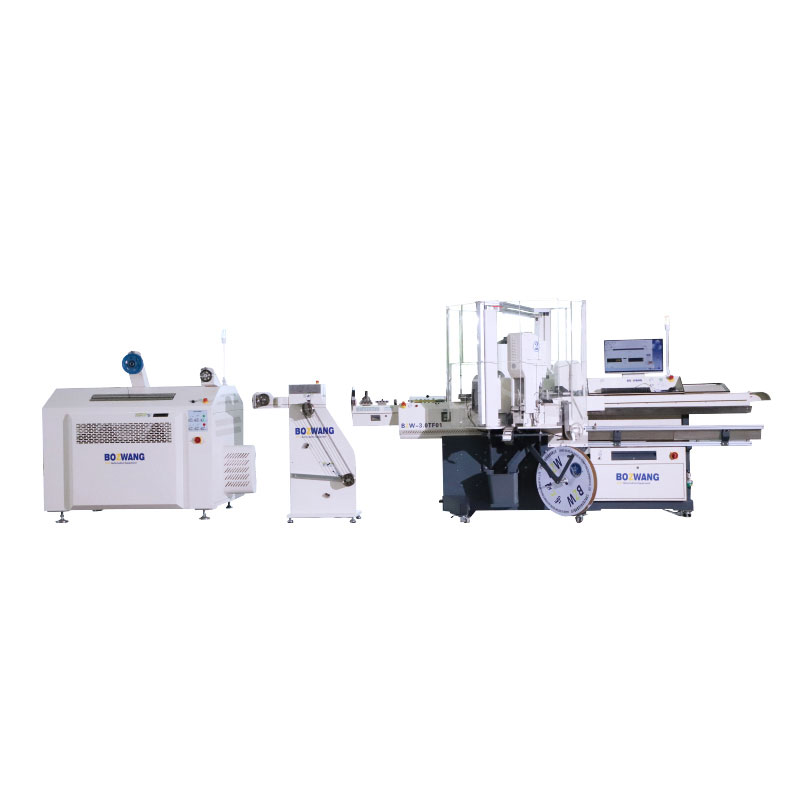
An automatic wire harness machine can combine cutting, stripping, marking, crimping, seal insertion, vision inspection, and bad-part ejection into one synchronized cell. A more advanced automatic wire harness machine can handle FAKRA RF connectors with shield brushing, HSD differential pairs with precise twist control, or Ethernet cables with tight impedance requirements.
BOZWANG’s FAKRA, HSD, and Ethernet intelligent lines are examples of complete automatic wire harness machine systems. They use Mitsubishi/servo motion architectures, CCD inspection, crimp-force monitoring, laser/ink marking, and MES uplink. Each automatic wire harness machine stores process recipes, tracks cycle counts, and generates audit-ready production reports.
For new-energy customers, BOZWANG builds HV cable lines where an automatic wire harness machine strips thick insulation, processes shields, crimps large terminals, tests contact resistance, and labels the finished harness—all without manual transfer between benches.
The value of an automatic wire harness machine is not only labor saving. It is process control. When the machine owns the process, quality stops depending on individual operator skill.
Automatic Wire Harness Equipment: The BOZWANG System Approach
When we say automatic wire harness equipment, we mean the full toolkit: pre-feeders, straighteners, cut-strip machines, crimp presses, applicators, seal inserters, ultrasonic welders, taping machines, winding/tie machines, test stations, vision systems, conveyors, and software.
BOZWANG does not only sell boxes. The company sells automatic wire harness equipment as a production system. That means:
Standardized mechanical platforms
Modular stations that can be recombined
Unified HMI and recipe management
MES/ERP connectivity
Remote commissioning and video support
Spare-part packages for export markets
Process know-how for FAKRA, HSD, Ethernet, PV, and EV harnesses
A customer buying automatic wire harness equipment from BOZWANG gets more than a machine catalog. They get a process partner who understands strip lengths, terminal heights, shield fold-back tolerances, tape overlap, weld energy, and production documentation.
This system approach is why BOZWANG equipment appears in automotive, new-energy, photovoltaic, telecom, and industrial harness environments across many countries.
Core Categories of Wire Harness Manufacturing Equipment
A professional harness plant typically runs several equipment groups:
Each category can exist alone, but the competitive advantage comes when they work as one connected line.
FAKRA, HSD, Ethernet, and EV: Why Purpose-Built Machines Win
Generic equipment can make simple harnesses. But FAKRA RF harnesses need precise shield treatment. HSD lines need controlled twist and impedance discipline. Ethernet harnesses need clean pair handling. EV HV harnesses need big cross-section stripping, heavy crimp force, and strict safety interlocks.
BOZWANG builds purpose-designed lines for these products. A FAKRA line is not just a wire harness crimping machine with a different fixture—it is a complete process cell with shield flipping, aluminum-foil removal, terminal insertion, CCD check, and traceability.
An Ethernet line is not just another automatic wire harness machine—it manages pair separation, strip depth, twist recovery, and contact positioning. An EV line treats an Ultrasonic wire harness welding machine or heavy crimp press as a safety-critical station with full data logging.
This is why “buy a machine” is the wrong mindset. The right mindset is: buy wire harness manufacturing equipment engineered for your product family.
Quality, Certifications, and Global Support
BOZWANG’s Changzhou base covers about 45,000 m², with hundreds of employees and a large engineering team. The company has passed ISO 9001, ISO 45001, CE, and TÜV-related quality disciplines, and is recognized as a national-level “Little Giant” specialized enterprise in China.
Every automatic wire harness machine is backed by process engineering: blade selection, applicator design, crimp-height optimization, weld-recipe development, tape-tension tuning, and MES integration.
BOZWANG serves customers in Europe, North America, the Middle East, Asia, and other regions. Support includes video commissioning, spare parts, applicator service, software updates, and line-expansion planning.
For buyers, this means lower risk. You are not importing a black-box machine; you are working with a manufacturer that understands harness process engineering.
How to Choose the Right Wire Harness Manufacturing Equipment
Before purchasing, ask:
What wire gauges and cable types must be processed?
Do you need single-end, double-end, or sealed-terminal crimping?
Will you process FAKRA, HSD, Ethernet, PV, or HV products?
Do you need MES traceability and crimp-force monitoring?
Is ultrasonic splicing required for copper/aluminum bonds?
What tape types and wrap patterns are needed?
What is your target cycle time and first-pass yield?
Do you need local service, spare parts, and remote support?
If the answer to most of these is “yes,” then standalone hand tools are not enough. You need automatic wire harness equipment with industrial controls and documented process capability.
Why Choose BOZWANG as Your Wire Harness Equipment Manufacturer
Choosing BOZWANG means choosing a manufacturer that lives inside the harness process every day.
Deep product focus. BOZWANG does not spread into unrelated machinery. The company specializes in wire harness manufacturing equipment, from a single Wire harness cutting and stripping machine to full FAKRA/HSD/Ethernet/EV lines.
Complete process coverage. Cutting, stripping, crimping, sealing, ultrasonic splicing, taping, testing, and data tracking can all be supplied from one source.
Strong crimping and welding know-how. BOZWANG’s wire harness crimping machine platforms and Ultrasonic wire harness welding machine systems are built for automotive-grade repeatability, not just basic termination.
Smart factory readiness. BOZWANG automatic wire harness machine systems support recipe management, CCD inspection, crimp-force monitoring, and MES uplink.
Global service mentality. With export experience across many countries, BOZWANG provides commissioning, spare parts, training, and process support—not just shipment and invoice.
Scalable automation. Start with one wire harness tape wrapping machine or cutter, then expand into a modular line later. BOZWANG platforms are designed to grow with your business.
Proven industries. Automotive, EV, energy storage, photovoltaic, 5G/ethernet communications, industrial control, and appliance harness manufacturers already use BOZWANG machines.
Engineering partnership. BOZWANG helps customers optimize strip length, crimp height, shield folding, weld energy, tape overlap, and overall line balancing.
In short: BOZWANG combines Chinese manufacturing cost-efficiency with international-quality automation engineering. That is why more global harness plants treat BOZWANG as a long-term equipment partner rather than a one-time supplier.
5 FAQs: Wire Harness Manufacturing Equipment
Q1. What is the most important first investment for a harness factory?
A Wire harness cutting and stripping machine is usually the best starting point. Accurate cut length and clean strip quality affect crimping, welding, insertion, and final electrical performance. If this step is unstable, every downstream process suffers.
Q2. When should I choose an Ultrasonic wire harness welding machine instead of crimping?
Use an Ultrasonic wire harness welding machine when splicing many fine strands, joining copper and aluminum, building battery/busbar links, or eliminating solder/flux in high-current applications. Ultrasonic welding equipment gives low-resistance, clean joints with strong thermal and vibration performance.
Q3. Can a wire harness crimping machine handle sealed automotive terminals?
Yes. BOZWANG wire harness crimping machine platforms can be configured with seal/waterproof-plug insertion, dual-end crimping, flag-terminal crimping, and crimp-force monitoring. For automotive IP-rated harnesses, seal insertion and crimp height control are essential.
Q4. Is a wire harness tape wrapping machine really necessary if we tape by hand?
Manual taping works for prototypes, but production harnesses need consistency. A wire harness wrapping machine or wire harness tape wrapping machine controls tension, overlap, spiral pitch, and start/stop position. This improves NVH, abrasion resistance, appearance, and operator ergonomics.
Q5. Can BOZWANG equipment connect to our MES or Industry 4.0 system?
Yes. BOZWANG automatic wire harness equipment supports recipe storage, production counting, crimp-curve logging, CCD inspection records, alarm history, and MES/uplink data. This makes full batch traceability possible for automotive, EV, and telecom harness production.
Final Takeaway
Wire harness manufacturing has moved from hand tools to intelligent production systems. The modern factory needs reliable wire harness manufacturing equipment, high-precision automatic wire harness machine cells, robust wire harness crimping machine stations, advanced Ultrasonic wire harness welding machine technology, and consistent wire harness wrapping machine / wire harness tape wrapping machine finishing.
BOZWANG delivers these technologies as one connected ecosystem: engineered, certified, export-ready, and supported globally. Whether you build automotive RF harnesses, EV high-voltage assemblies, Ethernet data cables, photovoltaic strings, or industrial control harnesses, BOZWANG helps you move from manual inconsistency to automated, auditable, high-yield production.
If you are planning a new harness line—or upgrading an old one—the smartest first step is to talk with BOZWANG about a complete automatic wire harness equipment solution tailored to your product mix.
I want to comment
Recommended Products
BZW-1003FK FAKRA wire processing machine

BZW-6.0FK03 FAKRA semi-automatic wire cut and strip machine

BZW-9001 Intelligent wire harness processing center

BZW-2.5T-FBD Double wire semi-automatic wire stripping, seal inserting and crimping machine

BZW-2.5T-BDE Ethernet two-wire peeling and crimping machine

BZW-9A-02 Portable ultrasonic wire harness welding machine

BZW-9A-1 Ultrasonic wire harness welding machine

BZW-9A Ultrasonic wire harness welding machine

BZW-2.5T-BD Double wire stripping and crimping machine
BZW-2T-D Wire stripping and terminal crimping machine (Applicator changeable )


Recent News
1.Automatic wire stripping machine working principle
2015-07-242.How to choose the right wire stripping machine
2016-08-113.WIRE HARNESSES AND WIRE ASSEMBLIES
2017-08-234.Wire Harness Business & Strateg
2017-08-245.How to choose the right wire stripping machine
2018-03-286.The processing of electric vehicles wire harness is a big difficulty in wire processing industry.
2019-09-217.Best Automatic Wire Stripping Machine Picks for Industrial Cable Processing
2026-08-178.Top 10 ultrasonic wire harness welding machine manufacturers in the world
2026-08-31
View More(Total0)Comment lists